"There's nothing certain but death and taxes".
Say, where'd
THAT come from? Well, that's about the way the weekend went...(isn't the internet handy for things just such as this question:
"Several famous authors have uttered lines to this effect. The first was Daniel Defoe, in The Political History of the Devil, 1726: 'Things as certain as death and taxes, can be more firmly believed.'"Benjamin Franklin (1706-90) used the form we are currently more familiar with, in a letter to Jean-Baptiste Leroy, 1789, which was re-printed in The Works of Benjamin Franklin, 1817: 'In this world nothing can be said to be certain, except death and taxes.' "Hmmm- just what I thought. No doubt the
tea-party enthusiasts enjoyed extolling the former interpretation this past (Tax Day in the USA was April 15).
Anyway, unfortunate, but peculiarly fitting, I was working on taxes last weekend, and
The Buddy Holly Story was playing on television. (A 1978 movie, staring
Gary Busey. A bit of -ironically fitting- Busey trivia: "In 1975, as the character 'Harvey Daley,' he was the last person killed on the series Gunsmoke (in the third to the last episode, No. 633 - 'The Los Carnales'". (Okay, okay- I had to look it up too: "The Brotherhood"). An interesting- and shocking for anyone who has seen Gary Busey in, ah, anything lately: he was nominated for an Oscar for his portrayal of Buddy Holly (the movie won an Oscar for, logically, Best Music).
Anyway, enough of Gary Busey- how about the REAL Buddy Holly. (Well, the real Charles Holley, a.k.a.
Buddy Holly.
It's an unfortunate tale of Buddy Holly (age 22) and two other performers of musical persuasion (as opposed to performers of the tea-party persuasion),
"The Big Bopper" (Jiles Perry "JP" Richardson, Jr.) age 28, and
"Ritchie Valens" (Richard Steven Valenzuela) age 17, who were killed along with the pilot
Roger Peterson age 21, back in the early morning hours of February 3, 1959.
The story I was -vaguely- familiar with was something along the lines of the Wikipedia synopsis:
"Holly was offered the Winter Dance Party by the GAC agency, a three-week tour across the Midwest opening on January 23, 1959, with other notable performers such as Dion and the Belmonts, Ritchie Valens, and J. P. "The Big Bopper" Richardson. He assembled a backing band consisting of Tommy Allsup (guitar), Waylon Jennings (bass) and Carl Bunch (drums) and billed as The Crickets.
"The tour turned out to be a miserable ordeal for the performers, who were subjected to long overnight travel in a bus plagued with a faulty heating system in −25 °F (−31.7 °C) temperatures. The bus also broke down several times between stops. Following a performance at the Surf Ballroom in Clear Lake, Iowa on February 2, 1959, Holly chartered a small airplane to take him to the next stop on the tour. He, Valens, Richardson, and the pilot were killed en route to Moorhead, Minnesota, when their plane crashed soon after taking off from nearby Mason City in the early morning hours of February 3. Don McLean referred to it as "The Day the Music Died" in his song "American Pie"."I had generally attributed the accident to weather- probably icing, turbulence, or systems failure in blind conditions.
But...
As
Paul Harvey used to say (before he rendezvoused with Buddy, the Big Bopper, and Richie - just over a year ago, as a matter of fact: September 4, 1918 – February 28, 2009, R.I.P.), it's time for THE REST OF THE STORY...
Here's the
Civil Aeronautics Board report. (I found it a bit dismissive) -
"This accident, like so many before it, was caused by the pilot's decision to undertake a flight in which the likelihood of encountering instrument conditions existed, in the mistaken belief that he could cope with en route instrument weather conditions, without having the necessary familiarization with the instruments in the aircraft and without being properly certificated to fly solely by instruments".
The flight conditions, while bad, was not as brutal as the -25 degrees earlier encountered in the tour. A tour bus was used to transport the bands- but there was some severe weather, and the bus had numerous mechanical problems- including the heater- the Big Bopper and Richie Valens both had colds from conditions in, and out, of the bus. Buddy had rented the airplane for only his own band, but they gave up their seats for the ailing Big Bopper and Valens;
Waylon Jennings "Jennings admitted that, in the years afterward, he felt severe guilt and responsibility for the crash. After Jennings gave up his seat, Holly had jokingly told Jennings, 'I hope your ol' bus freezes up!' Jennings shot back facetiously, 'Well, I hope your ol' plane crashes!'";
Tommy Allsup "a coin flip Allsup had with Ritchie Valens on February 2, 1959 that saved Allsup's life"; the other member,
Carl Bunch was previously incapacitated:
"The tour bus heater failed, and Bunch suffered from frostbite and was hospitalized".
Not quite as glamorous as today's rockstar acoomodations.
The C.A.B. report comments on the pilot,
"Roger Arthur Peters, 21 years old, was regularly employed by Dwyer Flying Service as a commercial pilot and flight instructor, and had been with them bout one year. He had been flying since October of 1954, and had accumulated 711 flying hours, of which 128 were in Bonanza aircraft. Almost all of the Bonanza time was acquired during charter flights. He had approximately 52 hours of dual instrument training and had passed his instrument written examination. He fail an instrument flight check on March 21, 1958", but this was some nine months prior to the accident.
The pilot does seem to have been conscientous, and alert to the potential of weather complications-
"At approximately 1730, Pilot Peterson went to the Air Traffic Communications Station (ATCS), which was located in a tower on top of the Administration Building, to obtain the necessary weather information pertinent to the flight...At 2200 and again at 2330 Pilot Peterson called ATCS concerning the weather...At 2355, Peterson, accompanied by Hubert Dwyer, a certificated commercial pilot, the local fixed-base operator at the Mason City Airport, and owner of Bonanza N3794N (the aircraft used on the flight), again went to ATCS for the latest weather information...While the aircraft was being taxied to the end of runway 17, Peterson called ATCS and asked for the latest local and en route weather."The ceilings had decreased from 5000 ft in the early evening, to 3000 ft at the time of takeoff. The C.A.B. report continues-
"A normal takeoff was made at 055 and the aircraft was observed to make a left 180-degree turn and climb to approximately 800 feet and then, after passing the airport to the east, to head in a northwesterly direction. Through most of the flight the tail light of the aircraft was plainly visible to Mr. Dwyer, who was watching from a platform outside the tower. When about five miles from the airport, Dwyer saw the tail light of the aircraft gradually descend until out of sight. When Peterson did not report his flight plan by radio soon after takeoff, the communicator, at Mr. Dwyer's request, repeatedly tried to reach him but was unable to do so. The time was approximately 0100."Although light snow was reported at the time (and when the wreckage was found 8.5 hours later, there was 4 inches of snow on it), it would seem the snow wasn't extremely severe, if the 12 volt tail navigation light could be seen from the ground at 5 miles out.
But the weather was changing fairly rapidly-
(At 2330)"The Mason City weather was reported to the pilot as: ceiling measured 6,000 overcast; visibility 15 miles plus; temperature 15 degrees; dew point 8 degrees; wind south 25 to 32 knots; altimeter setting 29.96 inches.
"At 2355, Peterson, accompanied by Hubert Dwyer, a certificated commercial pilot, the local fixed-base operator at the Mason City Airport, and owner of Bonanza N3794N (the aircraft used on the flight), again went to ATCS for the latest weather information. The local weather had changed somewhat in that the ceiling had lowered to 5,000 feet, light snow was falling, and the altimeter setting was now 29.90 inches.
"The passengers arrived at the airport about 0040 and after their baggage had been properly stowed on board, the pilot and passengers boarded the aircraft. Pilot Peterson told Mr. Dwyer that he would file his flight plan by radio when airborne. While the aircraft was being taxied to the end of runway 17, Peterson called ATCS and asked for the latest local and en route weather. This was given him as not having changed materially en route; however, the local weather was now reported as: Precipitation ceiling 3,000 feet, sky obscured; visibility 6 miles; light snow; wind south 20 knots, gusts to 30 knots; altimeter setting 29.85 inches."The C.A.B. report continues-
"The accident occurred in a sparsely inhabited area and there were not witnesses. Examination of the wreckage indicated that the first impact with the ground was made by the right wing tip when the aircraft was in a steep right bank and in a nose-low attitude. It was further determined that the aircraft was traveling at high speed on a heading of 315 degrees. Parts were scattered over a distance of 540 feet, at the end of which the main wreckage was found lying against a barbed wire fence. The three passengers were thrown clear of the wreckage, the pilot was found in the cockpit...
"Although the aircraft was badly damaged, certain important facts were determined. There was no fire. All components were accounted fro at the wreckage site. There was no evidence of inflight structural failure or failure of the controls. The landing gear was retracted at the time of impact. The damaged engine was dismantled and examined; there was no evidence of engine malfunctioning or failure in flight. Both blades of the propeller were broken at the hub, giving evidence that the engine was producing power when ground impact occurred. The hub pitch-change mechanisms indicated that the blade pitch was in the cruise range."Given the ground observations, I'm not sure how pertinent to the accident the "Flash Adviosry" on weather was (although it could well have become a significant factor if the flight had continued much further)-
"Another advisory issued by the U. S. Weather Bureau at Kansas City, Missouri at 0015 on February 3 was: 'Flash Advisory No. 1. Over eastern half of Kansas ceilings are locally below one thousand feet, visibilities locally 2 miles or less in freezing drizzle, light snow and fog. Moderate to locally heavy icing areas of freezing drizzle and locally moderate icing in clouds below 10,000 feet over eastern portion Nebraska, Kansas, northwest Missouri and most of Iowa. Valid until 0515.' Neither communicator could recall having drawn these flash advisories to the attention of Pilot Peterson. Mr. Dwyer said that when he accompanied pilot Peterson to ATCS, no information was given them indicating instrument flying weather would be encountered along the route."Probably at least an equal factor to the pilot's lack of instrument rating, was the instruments he had available:
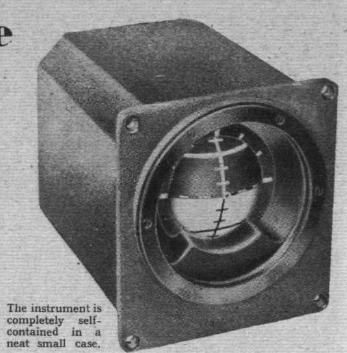
"When his instrument training was taken, several aircraft were used and these were all equipped with the conventional type artificial horizon and none with the Sperry Attitude Gyro such as was installed in Bonanza N 3794N. These two instruments differ greatly in their pictorial display...The conventional artificial horizon provides a direct reading indication of the bank and pitch attitude of the aircraft which is accurately indicated by a miniature aircraft pictorially displayed against a horizon bar and as if observed from the rear.. The Sperry F3 gyro also provides a direct reading indication of the bank and pitch attitude of the aircraft, but its pictorial presentation is achieved by using a stabilized sphere whose free-floating movements behind a miniature aircraft presents pitch information with a sensing exactly opposite from that depicted by the conventional artificial horizon.
"Service experience with the use of the attitude gyro has clearly indicated confusion among pilots during the transition period or when alternating between conventional and attitude gyros. Since Peterson had received his instrument training in aircraft equipped with the conventional type artificial horizon, and since this instrument and the attitude gyro are opposite in their pictorial display of the pitch attitude, it is probably that the reverse sensing would at times produce reverse control action. This is especially true of instrument flight conditions requiring a high degree of concentration or requiring multiple function, as would be the case when flying instrument conditions in turbulence without a copilot. The directional gyro was found caged and it is possible that it was never used during the short flight. However, this evidence is not conclusive. If the directional gyro were caged throughout the flight this could only have added to the pilot's confusion.
"It is believe that shortly after takeoff pilot Peterson entered an area of complete darkness and one in which there was no definite horizon; that the snow conditions and the lack of horizon required him to rely solely on flight instruments for aircraft attitude and orientation.
"The high gusty winds and the attendant turbulence which existed this night would have caused the rate of climb indicator and the turn and bank indicator to fluctuate to such an extent that an interpretation of these instruments so far as attitude control is concerned would have been difficult to a pilot as inexperienced as Peterson. The airspeed and altimeter alone would not have provided him with sufficient reference to maintain control of the pitch attitude. With his limited experience the pilot would tend to rely on the attitude gyro which is relatively stable under these conditions."The accicident airplane involved, was a Beech Bonanza , indeed, the first year of production-
"The aircraft, a Beech Bonanza, model 35, S/N-1019, identification N 3794N, was manufactured October 17, 1947. It was powered by a Continental model E185-8 engine which had a total of 40 hours since major overhaul. The aircraft was purchased by the Dwyer Flying Service, July 1, 1958, and, according to records and the testimony of the licensed mechanic employed by Dwyer, had been properly maintained since its acquisition. N 3794N was equipped with high and low frequency radio transmitters and receivers, a Narca omnigator, Lear autopilot (only recently installed and not operable), all the necessary engine and navigational instruments, and a full panel of instruments used for instrument flying, including a Sperry F3 attitude Gyro."Now, I don't want to stir up a beehive of frenzied Bonanza enthusiasts, but I'll quote from an article I found, on a
1965 S35 Bonanza- which is a six-seat model, 18 years newer than the original involved in the Buddy Holly accident-
"Recent photos of N1965Z were taken (May 2007) showing important structural safety modifications to the tail area. The vee-tail Bonanzas, particularly the early 35 models, have 24 times more incidence of in-flight airframe failures and breakups than the straight tail Bonanzas, which have an excellent safety record. The early vee-tail Bonanzas had thin-skinned wings without a shear web in the wing leading edge. The ruddervator tailplanes starting with the C35 model had increased area forward of the spar (leading edge 16 inches forward of spar) and showed a pattern of tail failures where the tailplane skin fails and folds over the spar, leading to loss of control. Actual separations of the control surfaces from the vee-tail have occured. The vee-tailed models have very light ailerons and low lateral stability, causing 'spiral divergence'. If a wing drops a little, it tends to keep dropping with low rolling stability, unless caught by the pilot and corrected. In IFR conditions or storm turbulence the stable flight situation can quickly get out of hand, leading to a 'graveyard spiral'.
"Intrinsic low longitudinal stability or rearward c.g. limit exceedances of the Bonanza's already narrow c.g. envelope can quickly lead to airspeed and altitude excursions. The c.g. moves aft as fuel is burned due to the wing leading edge fuel tank locations. Remember to observe that the maneuvering speed is less than the cruising speed. A moderate or abrupt control wheel pullup under such cruise speed conditions can easily exceed g limits with high destructive airframe forces. The Bonanza does have a sharp stall characteristic with little aerodynamic buffeting. With any back seat passengers, the aft c.g. limit may be easily exceeded, exacerbating the stability problem with an illegal flight condition.
"Also, the ruddervators are sensitive to flutter from any imbalances. Repainting the aircraft requires careful measurement and rebalancing the tail, by removing and weighing all components. As little as two ounces of imbalance can be dangerous, causing flutter under some flight conditions. The ruddervator must be within specified weight and balance conditions. N1965Z has several mods to strengthen the leading edge of the ruddervator's tailplanes. Several A.D.s (airworthiness directives) have been issued by the FAA pertaining to conditions that could lead to flutter and its destructive effects in vee-tail Bonanzas."Okay- before I get a load of bombs dropped on my head, I'll point out the accident airplane was NOT a C-model or newer, with the propensity for structural failure due to the (ill-supported) extension of the stabilator leading edge. BUT- I would question why a 9-inch extension of the stabilator leading edge was needed- perhaps to improve the "spiral divergence"?
(And the 1947 model did NOT have the extra row of seats in back. I suspect the rather skinny Buddy Holly and Richie Valens (age 22 and 17 respectively) being young and a product of the less "portly" 1950's, did not present any c.g. challenges, despite the somewhat more "substantial" Big Bopper being onboard.
But the Buddy Holly plane did not have the extra 18 inch fuselage length, nor larger tailplanes, so I would expect it to be a bit more fidgety in turbulence. (How's THAT for being diplomatic! :)
Another factor is pilot fatigue- even though the flight was just minutes old, I wonder how well rested the pilot was-
"On the evening of February 2, 1959, the manager of the Surf Ballroom in Clear Lake contacted Peterson to arrange a charter flight from Mason City to Fargo, North Dakota. The Ballroom was hosting the Winter Dance Party that evening and one of the tour's performers, Buddy Holly, wanted to fly ahead of the rest of the tour members, who were traveling by bus. Peterson agreed to take the flight, and when the performers arrived at the airport, he learned that in addition to Holly, his other two passengers would be Ritchie Valens and J.P. 'The Big Bopper' Richardson."It sounds like a spur of the moment arrangement, the pilot had probably been up since 6 or 7 AM, going on 18 or 19 hours at the time of the accidemt.
The proverbial accident chain, is more like a wobbly stool at this point:
1) Relatively low time pilot
2) Probably ill-rested pilot
3) Aircraft with demanding flying characteristics
4) Non-standard instrumentation (for the era)
5) Weather conditions which exacerbated all of the above
A most tragic confluence of circumstances...
Here's a picture of the
Sperry F3 Attitude GyroAnd a
discussion of attitude presentation conventions.
The theory/speculaton of Bonanza flight characteristics arose from some conflicting information:
The C.A.B. reported-
"Examination of the wreckage indicated that the first impact with the ground was made by the right wing tip when the aircraft was in a steep right bank and in a nose-low attitude. It was further determined that the aircraft was traveling at high speed on a heading of 315 degrees. Parts were scattered over a distance of 540 feet...All components were accounted fro at the wreckage site. There was no evidence of inflight structural failure or failure of the controls." But
this narrative notes (with a lot of other interesting non-crash related items)-
"Part of the tail was found 1/4 mile away and a wing was found 1/2 mile away."Which if true, seems to support the spiral divergence/structural breakup scenerio...
Also, the
coroner's report notes-
"The main part of the plane lay against the barbed wire fence at the north end of the stubble field in which it came to earth. It had skidded and/or rolled approximately 570 feet from point of impact directed northwesterly. The shape of the mass of wreckage approximated a ball with one wing sticking up diagonally from one side." Here's a
picture of the airframe. (It looks like the left wing is the one still "attached"- from the pitot probe and airleron orientation? A right side impact would have probably sheared off the right wing...but a separated right wing would be consistent with the impact orientation- I'll trust the C.A.B. report...mostly- it would sure be interesting to read local paper accounts).
Here's a couple of accounts of the tour "the boys" were on:
Winter Dance Party MapWinter Dance Party ItineraryThat was a rigorous tour!
Interesting to note the
Surf Ballroom in
Clear Lake, Iowa is still open. (Last year was the
50th Anniversary Commemoration of the last performance). Going to see a show there? Considering the circumstances, I don't know as I'd recommend
flying in. But I don't think I'd take a bus either!
 Not to bring a dark cloud to our generally cheerful and enlightened conversation, but I read some troubling news regarding potential developments at one of the largest General Aviation manufacturers this past week. The Machinist union leadership had discussions with HawkerBeech, and afterwards issued a rather alarming press release, to the effect that,